Twenty-One

“You know only a heap of broken images,” wrote T. S. Eliot.

This line captures the state of Christianity for many Americans. The faith’s ancient symbols - eternal life, eating flesh, drinking blood - can feel like images of a 1950s magenta-carpet religion. This drives the anxiety that the core message of Christianity will be lost to the next generation.

***

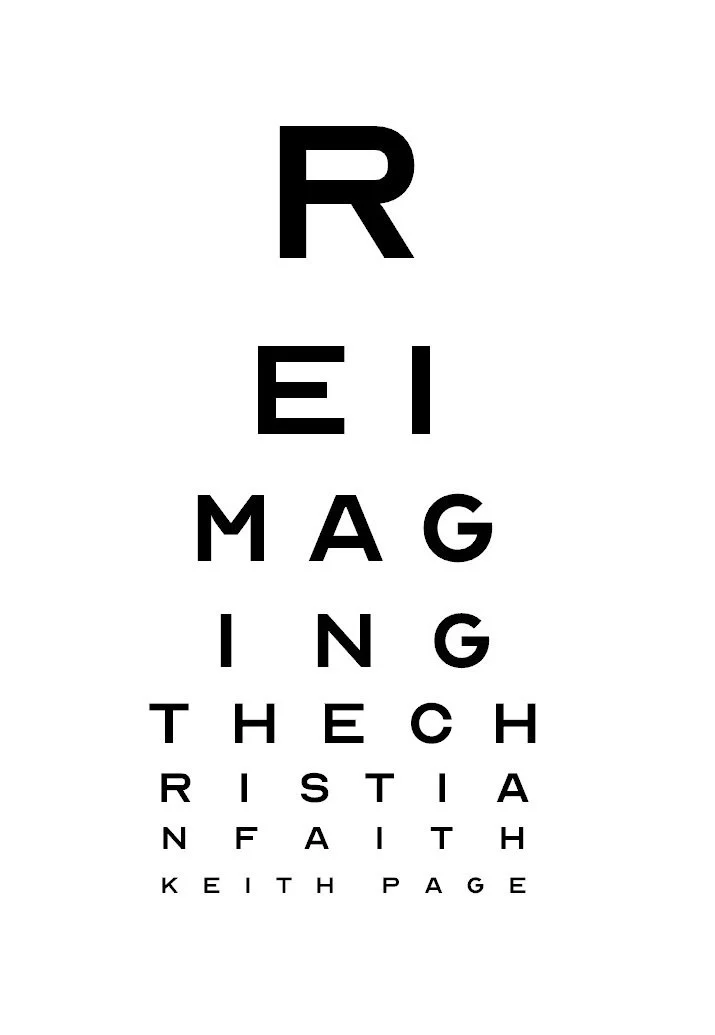
Twenty-One offers a new kind of apologetics: it re-images the experiences of a Christian worldview for a culture that is now shaped by pictures as much as by text.

Learn a Christian worldview in images native to the twenty-first-century, such as:

  • A 747’s black box

  • a Tesla in Autopilot Mode

  • surgery

  • a greenhouse

Author

  • KEITH PAGE

    Keith is a staff member at the University of Virginia. He previously served as a theology teacher and chaplain at a classical Christian school. He holds a master’s degree in theological studies from Duke Divinity School.

Excerpt from Twenty-One

Chapter 1

THE GROUND WE STAND ON – our continents and oceans – our entire civilization – is a mote of dust. We are surrounded by an eternity of unfathomable space. When an Apollo 17 astronaut near the moon took a famous photo of earth resembling a blue marble in the black void in 1972, the world was stunned by how puny we looked. There we were: all of us. Just a tiny speck. The astronauts could hold out their gloves and pinch the blue marble between their fingers. The smallness of the earth is a well-known scientific fact: and yet if we were to step back for a minute, and think of the way that people viewed the world before the Apollo moon landing and before modern science, we know that humanity used to have a grandiose idea of itself; before we knew about red giants and white dwarfs and faraway suns and the Andromeda galaxy, we used to think of ourselves as magnificent, and the universe as small. Due to the progress of the Enlightenment and the advance of reason, humanity has finally understood its place in the universe.

Or… maybe not.

It’s worth wondering whether people in generations past actually had a more accurate view of our place in the universe. Shepherds, goatherders, farmers, oarsmen, quarrymen, smiths, carpenters – no, they had not yet got the scoop on black holes. They didn’t measure the distances of galaxies in parsecs. But somehow, they knew their relative position in the scale of things better than we do.

How did they know that?

It turns out that it’s not science which gives us our sense of scale and our place in the universe. Religion gives us that.

Religious people feel in their bones the ancient, spiritual connection between the words human and humility. They know that to be human is to be a small, finite product of the humus, the dirt – as Genesis says, “for dust you are, and to dust you will return.”

This ancient scale came from working in the humus, the dirt. People were dependent on soil, light, rain, and animal fertility. This interconnectedness of it all is the root of religion – a word which actually has to do with the bonds and connections that we experience.

Just being out in the open sky at night tending the herds and seeing the diamonds above you could alone give you this sense of scale in a way that no scientific data could ever offer.

But all of this, even if you could add it all up into one giant wow, pales in comparison to the sense of scale here. The universe is still way, way, way bigger than any of our mental models of it. Even if you watched scientific video after video to knock it into your thick skull, still, at the end of it, you’d be way off. You’d still picture yourself greater than you are and the universe as smaller than it is. This is the first axiom of theology.

The Creator is still way, way, way greater than the mental model that a creature can have about Him. On the order of billions of times greater. Or trillions of times greater. (And it might be worth remembering that, yes, there is a creator: the more we learn about the fundamental forces of the universe, the more the idea that we self-generated seems mathematically improbable. If our universe was the product of random forces, then the chances of getting one so well-ordered as ours are the chances of flipping a galaxy a quintillion times and a quintillion times it landing heads. What are the chances? Astronomically low.) So numbers cannot express the chasm between the creator and any mental models of the creator: we have to push it all the way to infinity.

This is where we must begin.

All talk about God is unserious unless it begins here. Unless we begin here, face-to-face with our dizzying smallness, we are not serious. Unless we begin with a tingling of the skin and a knot in the stomach at this creator, we’re merely scratching the surface. “The fear of the Lord is the beginning of wisdom” (Proverbs 9:10). It’s important to remember that the fear of the Lord is not like the fear of a child cowering from punishment: it is the fear of a “tiger burning bright, in the forests of the night.” Or of Job seeing a whirlwind. It is like throat-crushing awe at the infinite size of space. This is a fear grounded in realizing this “you” in the center of your egocentric universe is puny. This is the beginning of wisdom: and so any other attitude from which one may begin to think or write about God is unsound.

Unless we begin here, we just don’t get it.

Without beginning here, “Religion” is just a major in college. Without this axiom, all theories and theological arguments are only a vanity of vanities. Without this, “worship services” are mere entertainment.

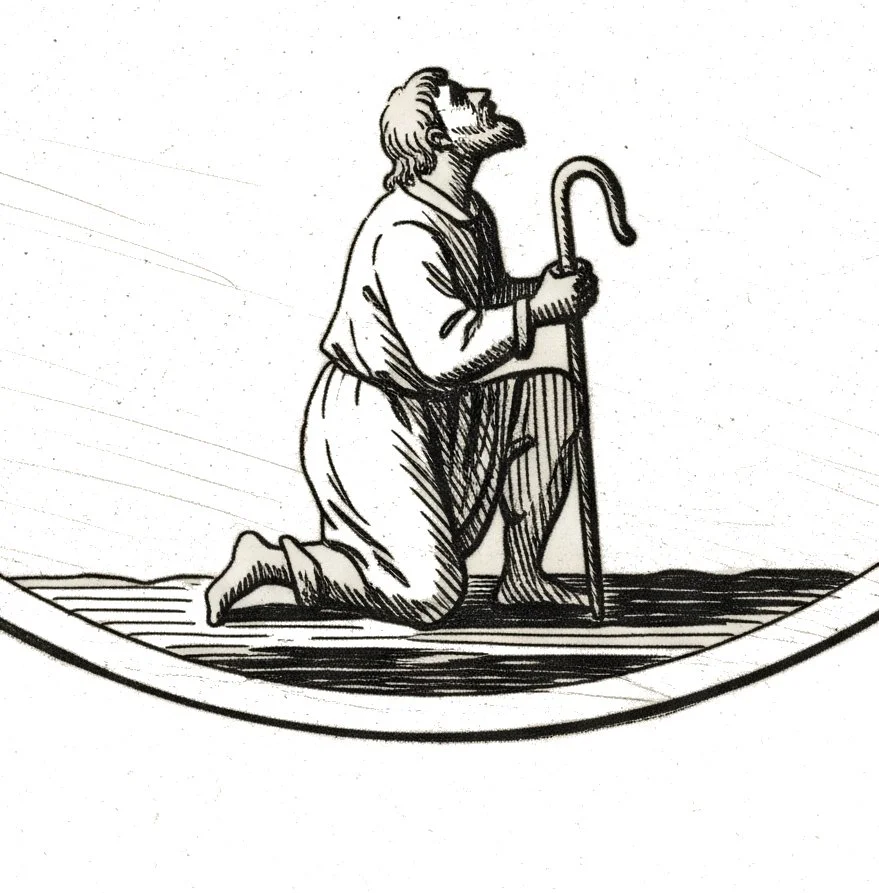
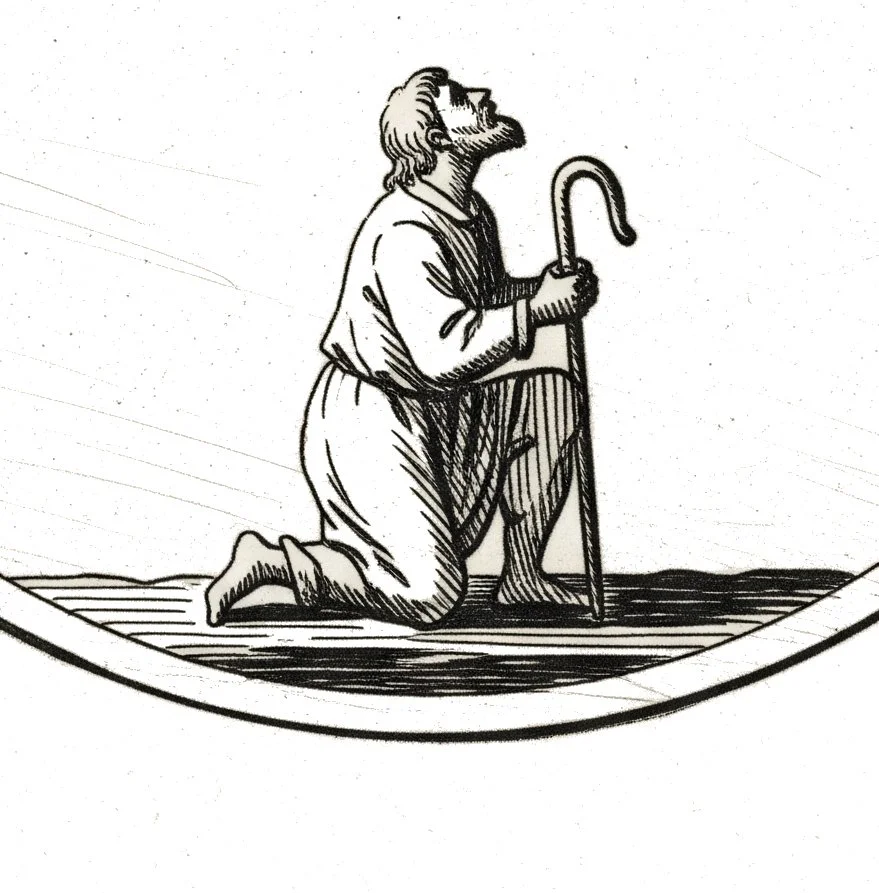
fig. 1

We Aren’t the Center of the Universe

The way out of this is to join countless generations who knew the ancient connection between human and humility. Touch the humus. (Not the chickpea dip, no, that is hummus.) Kneel. Hike in the majestic mountains and feel like an ant in the scheme of the cosmos. Leave the city behind. Look skywards in a cathedral.

This is the beginning of wisdom.

The first Christian experience for us to re-image is humility. Now if you were to take humility all the way to its logical conclusion, it wouldn’t just be a religious tingle in your gut once in a while. You’d know that you weren’t the center of the universe. You’d finally “get it.” The first axiom of theology of the infinite magnitude of God would be fundamental to your perception. What that would lead to is the experience of removing yourself from the center of the universe – a kind of permanent de-centering.

Let’s refer to this as The Copernican Experience.

This experience of being de-centered bears a likeness to the paradigm shift introduced by the astronomer Nicolaus Copernicus. That is why our first image is named after him.

Copernicus revolutionized the way that we think about the earth and the sun: you could say he was revolutionary about planetary revolutions. Astronomers used to model the sun revolving around the earth, but Copernicus introduced a more accurate model with the sun at the center. His heliocentric model of the solar system replaced the geocentric one.

To sum it up in a single phrase, Copernicus de-centered the earth.

The same thing goes with us at the beginning of religion. I said that this is where we must begin, for until we understand this, all talk about God is from our own imagination. When the God who reveals Himself in the Bible encounters humans, the one common thread that you notice is that He always has to de-center them first. De-centering acknowledges that the origin and center and end of all existence is infinite. All of a sudden, a self is de-centered. You – not your dopamine or brain chemicals or personal feelings for the day – you, did not make the world; you are not your own; you have encountered the holy and fixed and firm, and now you see yourself as secondary.

Get to know this in your gut, even in your diaphragm. As one of the Desert monks said, “A man must breathe humility and the fear of God just as ceaselessly as he inhales and exhales the air.”

I want to keep this brief, but you can see this happening to Moses and Abraham and Samuel and Isaiah and Job and the psalmists and Paul of Tarsus. For a taste, take a look at two individuals.

When Moses was in the Sinai desert and met the burning bush, he had no choice but remove his sandals out of reverence. The human had to touch humus. The voice speaking from the bush de-centered him.

Moses heard the voice call him by name, “Moses, Moses!”, and when he asked God for a name to call him back, the reply wasn’t a normal name. It wasn’t a transactional name. The answer came: “I AM WHO I AM.” He must have been floored. This divine name is a get-yourself-of-the-center-of-my-universe name, a name that makes you gobsmacked, for you have touched the ground of all being.

The second person with that effect was Jesus. When he spoke to people, he shouldered himself into the center of their universes. He never did it by force. Instead, he fascinated. Who knows how he did it? - was it in the way he looked into the bottom of their souls? - was it in his voice? - his almond eyes? - was it in how he said their names - “Mary” - “Simon, son of John”?

The starting point of Christianity is this: we walk around as little geocentric models.

Religion, nature, the soil, mountains, and wonder – they all tug at us, giving us the intuition, if only for a brief moment, that we aren’t the center of the universe. But the gravitational pull isn’t strong enough. So what we must first say about Christianity comes down to this: that the creator of the universe is not an aloof deist god, but has done something to pull at us. He wants to form us into heliocentric creatures. He worked through history to pull us into his orbit, one by one. That is why, at the end of his Divine Comedy, Dante describes everything circumnavigating Love in such perfect orbits that he is amazed to find that even he, the poet, is starting to revolve around God.

For now, though, let’s put our feet back firmly on terra firma.

We’re still humans who just don’t get it, who for some reason or other act like the center of our own universes. In the next chapter, we’ll see how this is rooted in our neurology.